

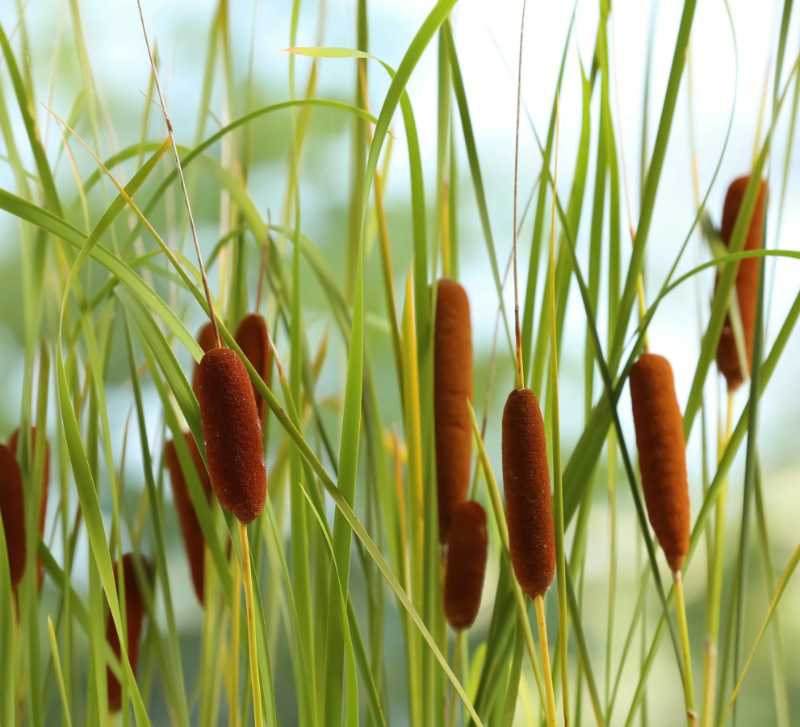
From plastic and glass to cattail and hemp – could our gardens eventually provide some of the raw materials we need?
We have become accustomed to recycling. We rinse out a glass bottle, put it into the recycling bin and trust that it will be collected, sorted and processed alongside thousands of others. The individual contribution is small, but the system makes it useful. Could we eventually apply a similar principle to plants grown specifically as sustainable raw materials?
That may sound rather fanciful, but the development of new uses for plants such as cattail, or Typha, and industrial hemp suggests the idea is not quite as far-fetched as it first appears. Research is increasingly examining plant fibres as alternatives to synthetic materials, with cattail attracting attention for its lightweight, hollow fibres and potential uses in insulation, cushioning and other products. Researchers at the Fraunhofer Institute in Germany have already developed Typha-based insulation boards, while more recent research is examining the plant as a source of natural fibres for a wider range of applications. Hemp is further down this road, with its fibres and woody inner stem already being investigated and used in construction, insulation and textiles. The UK Government has also identified hemp as having potential within the country’s future biomass economy.
The important point is that neither plant is being suggested as a miracle replacement for plastic. There are environmental costs involved in growing, harvesting, transporting and processing any material. But they demonstrate an increasingly important idea – plants can potentially become sources of materials as well as food, ornament and wildlife habitat.
And that is where gardening comes into the story.
For decades, many of us have gradually separated our gardens from the wider economy. A garden has become somewhere to relax, grow a few flowers, perhaps grow some vegetables and enjoy watching wildlife. If we need insulation, textiles, packaging or filling materials, we buy them from somewhere else. If we have garden waste, we put it in a bin and expect somebody else to deal with it. But perhaps there is another way of looking at our relationship with the land around us.
It doesn’t mean turning every garden into a commercial crop. Far from it. Instead, it means recognising that thousands of relatively small contributions can become significant if there is a system capable of bringing them together.
Perhaps we have forgotten the market garden
There is something interesting about comparing this idea with the old market garden. Our ancestors were generally much more aware that land was a resource. A garden could provide vegetables, fruit, herbs, seeds, flowers and materials, while surplus could be sold, exchanged or shared within the local community. During the Second World War, the Dig for Victory campaign demonstrated what could happen when millions of individual gardens and allotments were viewed collectively rather than simply as private spaces.
The lesson isn’t that we should return to the past. Modern agriculture, manufacturing and distribution exist for very good reasons and have transformed the way we live. But perhaps we could rediscover one particular principle from that period – you don’t necessarily have to produce everything yourself to make a contribution.
One garden might produce vegetables. Another could grow fruit. A community garden might produce seeds. Someone else could maintain a pond and wetland habitat. Another gardener might produce compost or leaf mould. A local farmer could grow a fibre crop. Put those things together and the collective contribution becomes considerably more interesting than any individual garden could manage alone.
The same principle could apply to materials.
Hemp is an obvious example, although there is an important legal distinction. In England, industrial hemp cultivation requires a Home Office licence and is restricted to approved low-THC varieties grown for legitimate industrial purposes such as fibre and seed. It therefore isn’t a case of suggesting that gardeners simply go out and sow hemp in their borders. A future community biomaterials scheme would need to be properly organised around licensed growers and legitimate processing.
Typha offers another possibility. The plant is naturally associated with wetlands and has been studied as a potential source of sustainable building materials. There could be environmental advantages in managing suitable wetland areas productively, although harvesting would obviously need to be carefully controlled to avoid damaging the very habitats that make those areas valuable.
That is why the idea needs to be approached as a potential community or agricultural system rather than a new gardening fad.
What if we had a biomaterials hub?
Imagine a local collection point where residents, community gardens, allotment associations and farmers could contribute specific plant materials grown or harvested for a known purpose.
A household might only have a small amount. A community garden could produce considerably more. A local farmer might grow a commercial fibre crop, while a wetland management project could provide sustainably harvested Typha. Once collected, the material could be dried, stored and transported to a processor in sufficient quantities to make the process commercially viable.
The household contribution would remain tiny.
The collective resource could be much larger.
And unlike putting general garden waste into a green bin, this would be about growing or managing plants because they have a specific material use. The end product could be insulation, fibreboard, cushioning, packaging or something else entirely.
There is already a familiar model for organising dispersed household contributions. The question is whether a similar infrastructure could eventually exist for renewable plant materials.
The garden doesn’t have to become a factory
There is an obvious danger here. We shouldn’t suddenly decide that every garden must justify itself by producing something commercially useful. Gardens are valuable precisely because they provide space for people and nature without needing to generate an economic return.
A rose doesn’t need to become a product. A butterfly doesn’t need to contribute to a supply chain. A garden pond doesn’t need to produce anything other than habitat.
But productive gardening and wildlife-friendly gardening don’t have to be mutually exclusive.
A garden can produce food and support pollinators. A hedge can provide wildlife habitat while producing flowers and seeds. A pond can support biodiversity while containing useful wetland plants. Composting can reduce waste while returning nutrients to the soil. A tree can provide shade, habitat and carbon storage before eventually becoming a source of timber.
Perhaps the opportunity is to stop thinking in terms of one function.
A garden can do several things at once.
From recycling waste to growing resources
That could represent a subtle but important change in how we think about sustainability.
Traditional recycling starts with something we have already consumed. We use it, collect it and try to recover some of its value.
Growing renewable materials starts somewhere else.
We deliberately grow something because it has a useful purpose.
The plant absorbs carbon as it grows. It becomes a raw material. It is harvested and processed into a product. Depending on the eventual application, that product may have further opportunities for reuse, recycling or recovery at the end of its life.
It isn’t automatically sustainable simply because it came from a plant. That would be far too simplistic. But it potentially gives us another option in a world where we are trying to reduce our dependence on fossil-derived materials.
And perhaps that is where gardeners could have a role.
Not as manufacturers.
Not as industrial farmers.
But as contributors.
The Gardening News question
Typha and hemp aren’t going to replace plastic and synthetic materials overnight. They may never replace some of them at all. But they represent an interesting direction in which plants become part of the material economy rather than simply something we grow for food or decoration.
And perhaps that brings us back to the humble garden.
One garden will not solve the plastic problem. One household won’t produce enough plant fibre to insulate a house. One allotment won’t supply an industrial manufacturer.
But a thousand gardens, allotments, community growing spaces, wetlands and farms working within a properly organised system could contribute something meaningful.
Perhaps the garden of the future doesn’t need to be more productive because every square metre has to earn its keep.
Perhaps it simply needs to be connected.
Connected to the community. Connected to nature. Connected to food production. And, potentially, connected to the materials we need.
We shouldn’t abandon the ornamental garden or turn gardening into another form of industrial production. But perhaps we have forgotten something our grandparents understood rather well – a small piece of land can contribute something useful to the wider community.
Maybe the future of recycling isn’t just about collecting what we throw away. Maybe it is also about growing some of what we need.
And if that sounds like a return to the old market garden, perhaps that isn’t such a bad thing after all.