

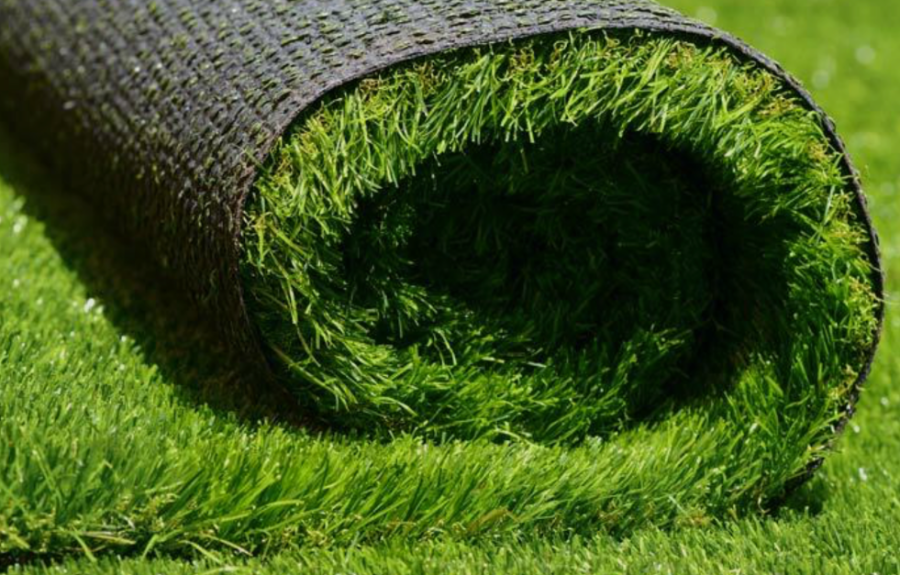
For years, artificial grass has been sold as the sensible modern solution to a changing climate. Less watering. Less mowing. Always green.
On the surface, it sounds like progress.
But beneath that plastic sheen, a much more troubling story is emerging – one that’s becoming harder to ignore.
The Microplastics Problem We Can’t Sweep Away
Artificial turf isn’t just a static surface. It breaks down. Constantly.
Every footstep, every match, every season of weather slowly degrades it. Fibres snap, infill shifts, and tiny plastic particles are released into the environment.
The scale is staggering. The European Chemicals Agency estimates that around 16,000 tonnes of microplastics are released from artificial turf across EU countries every year.
Step back and think about that. That’s not a marginal issue – that’s industrial-scale pollution.
Even more concerning, a recent systematic review suggested artificial turf could account for somewhere between 12% and 50% of global microplastic pollution. The upper end may be debated, but even the lower estimate places it firmly among the major contributors.
And unlike many sources of pollution, this one is entirely avoidable.
It Doesn’t Stay Put
There’s a common assumption that fake grass is contained – that once it’s laid, it stays there.
It doesn’t.
Each pitch can lose up to 8% of its synthetic fibres every year, alongside tonnes of rubber or polymer infill. These materials don’t politely remain on the field. They travel:
- Washed into drains during heavy rain
- Carried on boots and clothing
- Blown into surrounding soil and habitats
- Cleared away with snow or maintenance
From there, they enter waterways, soils, and eventually the food chain.
This is how microplastics move – quietly, invisibly, and persistently.
Regulation Is Catching Up – Slowly
The European Commission has already taken a step by legislating to ban granular polymer infill from 2031.
That’s significant. It’s also an admission that the current system is not sustainable.
But 2031 is still years away. And crucially, that ban targets one component of artificial turf – not the plastic carpet itself.
The wider issue remains: we are still installing vast areas of a material we already know will become pollution.
The Water Argument – Valid, But Misused
Let’s be fair. Artificial grass didn’t rise in popularity without reason.
In hot, dry regions – particularly Mediterranean climates – reducing water use is a real and pressing concern. Maintaining traditional lawns can be resource-intensive, and in those contexts, alternatives matter.
But here’s the problem: that argument has been exported wholesale into regions where it doesn’t hold the same weight.
In places like the UK, where rainfall is relatively abundant, the water-saving benefit is far less compelling. Yet artificial grass adoption has surged just the same – in gardens, schools, housing developments, and public spaces.
What started as a climate-specific solution has become a convenience product.
And convenience is a poor justification for long-term environmental damage.
What We Lose When We Lay Plastic
Beyond microplastics, replacing living ground with synthetic turf strips away something deeper.
Real grass – and more importantly, diverse planting – supports life. Even a modest lawn can:
- Absorb rainwater and reduce flooding
- Cool the surrounding environment
- Support insects, birds, and soil organisms
- Improve mental wellbeing through contact with nature
Artificial grass does none of these things.
It creates a surface that looks alive but is ecologically inert.
And once installed, it often leads to a wider loss of planting – fewer borders, fewer habitats, fewer opportunities for nature to return.
Better Alternatives Already Exist
This isn’t a choice between plastic grass and a thirsty, high-maintenance lawn.
There’s a growing middle ground – and it’s far more interesting.
For domestic spaces:
- Drought-tolerant planting schemes
- Wildflower lawns or mixed swards
- Clover-rich lawns that stay green with less water
- Gravel gardens with planting pockets
- Mulched beds and ground cover plants
For sports and public spaces:
- Improved natural turf management
- Hybrid systems with minimal synthetic reinforcement
- Investment in drainage and soil health rather than surface replacement
None of these are perfect. But they’re all part of a living system – not a disposable one.
Time to Change Direction
Artificial grass had its moment. It solved a problem in specific conditions. But its widespread adoption has outpaced our understanding of its consequences.
Now we know better.
We know it sheds microplastics.
We know it contributes to long-term pollution.
We know it replaces living ecosystems with inert surfaces.
And we know there are better options.
Phasing it out isn’t about going backwards – it’s about choosing solutions that work with nature, not against it.
Because a surface that looks green is not the same as one that is green.
And that distinction matters more than ever.